Ink Primer
In the fountain pen hobby there are three pillars that make a good writing experience. The pen, the ink, and the paper. The pen usually gets most of the spotlight, so for these next two weeks I thought that I would focus on the other two parts of that combination. First up will be ink.
What is ink made of?
This question will help structure the rest of the article. Regular (non-iron gall) water soluble fountain pen ink is made up of, more or less, 5 main ingredients. Water (duh), dye, a surfactant, a humectant, and a fungicide.
The Dye
The dye in fountain pen inks are slightly mysterious things. I really fell down the rabbit hole looking into this, and there are many different theories about what dyes are used by the larger ink manufacturers. I think that its safe to say that there are many different types of dyes that can be used in fountain pen inks and that depending on the desired color and properties, different types of dyes are used.
The dyes in food coloring and fabric dye should be suitable for making your own fountain pen ink if you are so inclined. Nearly any dye can be used to make an ink though whether it can be used to make fountain pen ink that you would feel good about putting into your $1000+ (or even your $30 TWSBI) pens is another story.
Unless there is something that I’m missing here, there are only two requirements for a dye to be suitable for fountain pen ink. It must dissolve in water without falling out of the solution and it must be compatible with the materials in a fountain pen. Water soluble dyes are fairly common and even some commercially available inks ask you to shake before using. The other requirement seems to be a more difficult one to ascertain: making sure that it doesn’t react with anything in a fountain pen. It is hard to tell how inks and pens will react to each other without testing.
There doesn’t seem to be a guide that shows which dyes will harm plastic when in constant contact. This is partially why there is some caution around Noodler’s inks. Nathan Tardiff of Noodler’s Inks experiments with new dyes all the time and therefore people after hearing of Noodler’s melting a pen feed are hesitant to use them (I use Noodler’s frequently and have never had anything happen with them).
The dye used will give the ink some of its more special properties. Noodler’s is a prime example of this type of experimentation, they have created waterproof inks that they call “Bulletproof”. These inks cannot be removed from paper by any normal means like bleach or ammonia. Side note, apparently someone had success with getting it off paper with a laser and then Nathan made a line of inks (Warden Series) that couldn’t be removed by lasers. You might have heard that these Bulletproof inks (not the laserproof ones I have no idea what makes them work) are “cellulose reactive”.
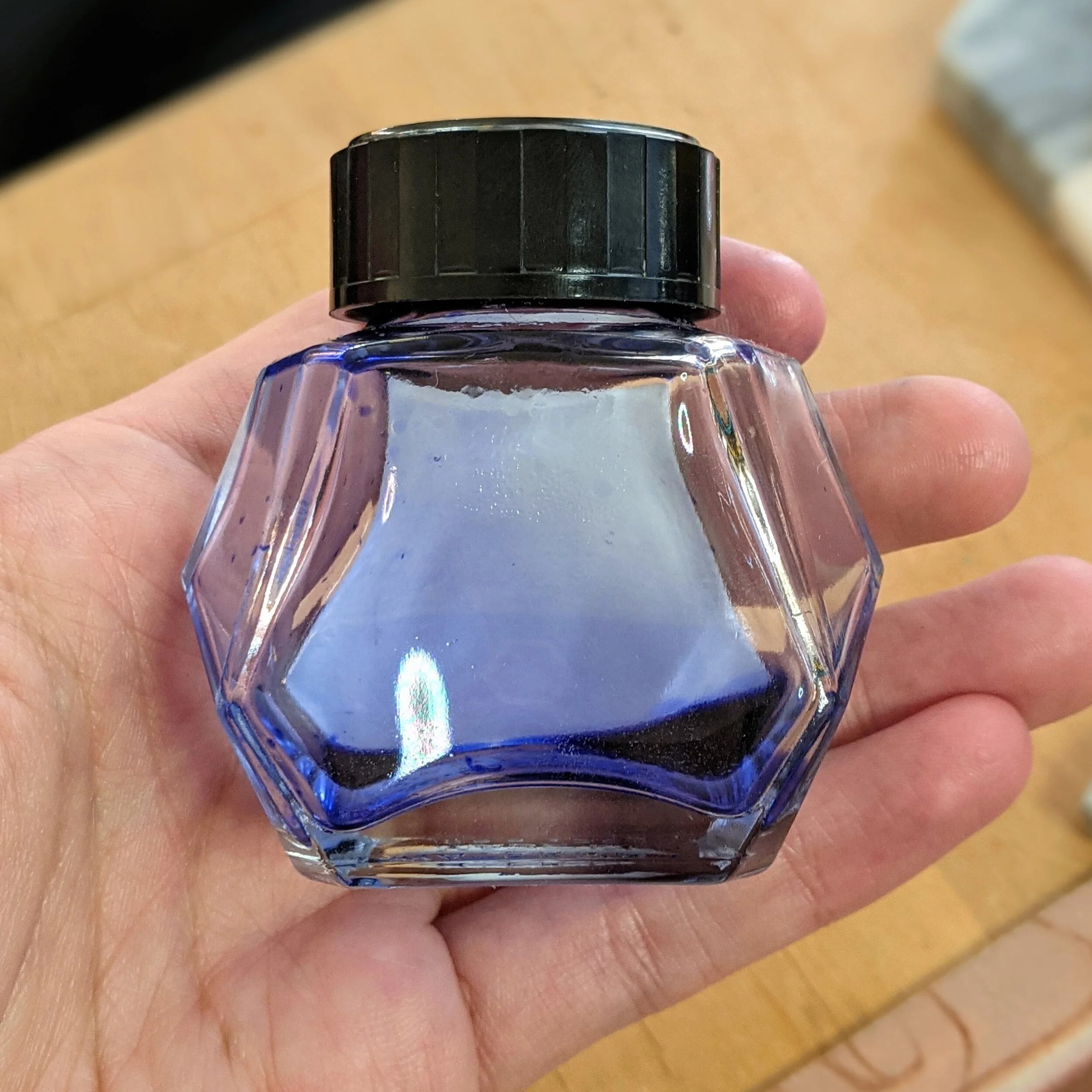
Based on this it is likely that Noodler’s uses a type of fabric dye that is cellulose reactive that is normally used to dye cotton. Cellulose can be found in fabric and in paper, and a cellulose reactive dye will do just as it sounds. It reacts with the cellulose and the products of the reaction will be linked to the paper and become basically impossible to remove (so be careful about spilling on cotton or wood as it may stain forever).
Most manufacturers will likely use different dye sources so its hard to generalize about what dyes are standard. In doing research for this I came across three different dyes that are at least comparable to what is used by the larger players. The first is triarylmethane dyes (which are related to the first synthetic dyes that are used in fountain pens created in the 1850s), the second is eosin, and the third is tartrazine. This should give you blue, red, and yellow respectively. Theoretically you should be able to make any ink based off of these three colors by combining them, but I know for a fact that there are many many colors of dyes that can be used which will have different properties (orange dye has a tendency to crust up pens).
Aniline dyes (the ones from the 1850’s) should also be suitable but they are slightly basic so you may have to balance with an acid such as acetic acid. Apparently they are not very fade resistant but the acetic acid makes them more vibrant. They are used now to stain wood mostly. I have some theories that this is what makes Noodler’s Baystate inks but that is just speculation on my part.
Dyes are somewhat complicated and difficult to find any information on, and while I have a passing knowledge in chemistry I’m slightly in over my head when it comes to dyes so I have only stuck with what I can be reasonably sure about. Hopefully some chemists that know more about the underlying mechanisms can email in if they notice anything that needs correction.
Surfactants
Surfactants are really what turns your dye filled water into ink. It is what lowers the surface tension in the water so that capillary action is stronger and the ink will flow better. For an explanation of the effects of capillary action in feeds, check out my article on feeds. Suffice to say that a surfactant increases the flow of the ink by allowing the ink to spread more easily rather than retract into itself.
Surfactants are found in detergents and soap and the lowering of the surface tension of the water is what allows soap filled water to make bubbles. The bubbles are able to form because the water is not as attracted to itself due to the decrease in surface tension.
Adding a surfactant will make the ink flow in the pen, but you have to use it very sparingly. The ratio that is generally stated is about 1%. If you add too much you will create an ink that feathers and spreads out on the page instantly absorbing into the paper. This is because without the surface tension to hold the ink together it will flow into the fibers of the page because of capillary action.
You can even add some surfactant into ink that you have that you think is a little too dry but I would only put it into a converter rather than into a bottle as it is very easy to put too much in. A common method is to dip a toothpick into dish soap and put that into a full converter (trust me, that might still be too much). You can also use Kodak Photo-Flo and Vanness even has their own version called White Lightning.
This debunks a common misconception that a dry ink needs more water, in fact a dry ink needs more surfactant. And counterintuitively if you add water to an ink you will be making that ink drier not wetter. This is because each ink already has some surfactant in it and by adding water you are diluting that surfactant.
Humectant
This is probably one of the ingredients that you haven’t heard of and one that does not get much attention but it does change properties of the ink that people really care about. The humectant is responsible for how fast the ink dries, both in the nib and on the paper.
The only humectant that I have ever heard of being used is glycerin. Its a thick syrupy liquid that is used as a sweetener in the food industry. It is hygroscopic meaning that it absorbs water, leading to its beneficial properties in ink. If you are making your own ink vegetable glycerin is suitable.
The more humectant that is added the ink the slower it will dry after it is put down onto the paper and the slower that your nib will dry out while it is uncapped. It is also possible that this will make sure that the ink does not feather by increasing the ink’s viscosity, though I am not entirely sure about this point.
I also have a theory (just my own theory) that when companies say an ink is lubricated this means the ink has extra humectants in it. Glycerin, or something similar, has been added to the ink and this makes the ink feel smoother across the page. This comes at the expense of the dry time which can be really long for a lubricated ink. One such example is Noodler’s Eel inks (I know I’m mentioning Noodler’s a lot, but they do have a lot of inks that push the envelope). These inks seem to have increased flow from extra surfactants and then extra humectants to make the nib slide across the page and take a long time to dry.
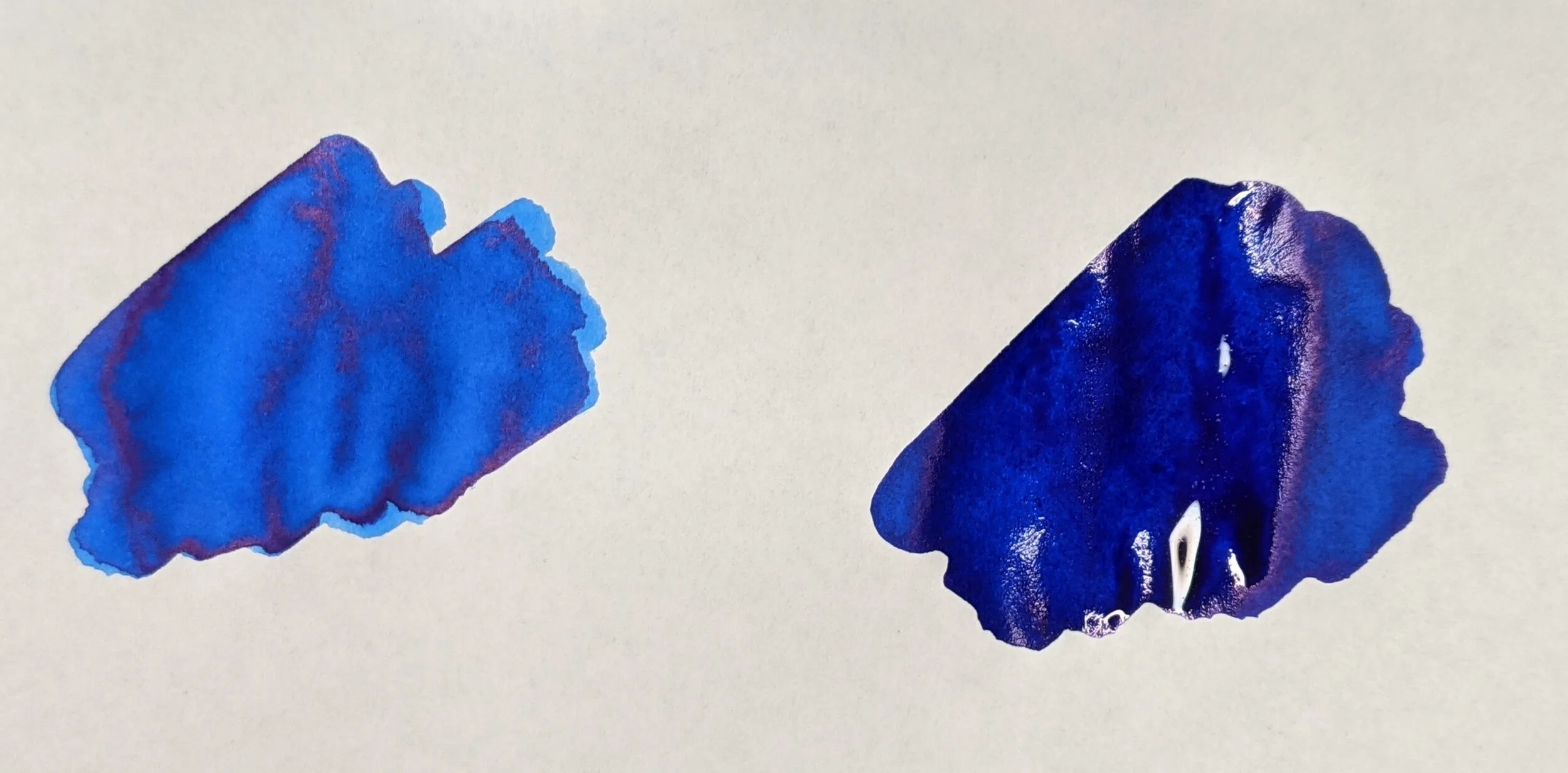
Kon Peki on the left and Noodler’s Eel Blue on the right. Both done at the same time on Tomoe River Paper.
I have not experimented a great deal with humectants but for certain they do increase drying times (on the page and in the nib) by absorbing moisture from the air.
Fungicide
A fungicide is exactly what it sounds like; it kills bacteria, mold and fungi. This is something that is essential that has to be added into inks so that they do not form any mold growth. Many of the things that are in ink, especially the glycerin, are prime targets for mold food. The wet environment and glycerin are the ideal home for a mold to start to grow.
This is another reason to be careful when making your own inks and when diluting inks. The less fungicide that is in your ink the more likely you are to get mold growth. The mold growth is most often seen as sludge that is at the bottom of an ink bottle and it really spells the end of any ink bottle. Once mold has really started to grow it will be very difficult to get it to stop growing and at that point you should just throw it away.
If you put ink with mold inside your pen you will be much likelier to have mold growth in your pen and that can be really annoying to get rid of and difficult to clean out. Some inks that are likely to grow mold are the Montverde inks, they have been known to grow mold much more than other inks. I have a suspicion that this is because they add extra humectant as their inks are advertised as lubricated. If you do get this problem however you can simply contact them and they will send you a brand new bottle.
Anything else?
There are plenty of other things that can be added into inks to give them a different look and different properties. This ranges in creativity and strangeness. There are also some properties of inks that I would be remiss to mention that I will cover here.
Sparkles!
This is the most common thing to add to a fountain pen ink these days that is none of the five above. J. Herbin inks, Diamine Shimmertastic, and wide range of Tono and Lims inks (who are really pushing what’s possible to put into an ink).
This additive is really very simple. It is just particles of a precious metal (or at least something that looks similar to one) that are floating in the ink. They are small enough that they should be able to fit into the ink channel without any real problems. There is some caution around these inks as they are seen as a clogging hazard. I find this caution to be a little unwarranted as it is simple in most cases to clean a pen out by flushing it (I wouldn’t use it in a vintage pen or your ink may have shimmer in it forevermore).
It is even possible to buy some shimmer and add it to any ink. I think that Tono and Lims also offers this type of particulate. I wouldn’t go dumping random metal shavings into your ink but you can certainly experiment and see what works. Gold, nickel, platinum, and rhodium seem to be the obvious choices due to their corrosion resistance. Iron, copper, and brass should be avoided due to corrosion issues (but just because something looks like it is that color in a commercial ink such as a J. Herbin ink doesn’t mean it actually is one of these metals, I think that most if not all inks like this on the market are safe).
Sheen!
This isn’t actually an additive but it does fit into the same category as shimmer in terms of how it looks. So what is sheen? Sheen just excess dye that has not absorbed into the page and is not sitting on top of the page. Certain colors of ink will provide a certain color based on the dyes that were used to make the ink in the first place. For example most blue/green inks (if they sheen) will sheen with red, the same goes for purple and gold, orange and green.
Some inks are known to be better sheeners than others and there are a couple of factors that lead to an ink sheening (Organic Studios Nitrogen, Diamine Skull and Roses, and Yama Budo come to mind) . Theoretically any ink can sheen if none of the dyes actually soak into the page, so the paper has quite an effect on this. If you use copy paper then there will be no sheen on any ink, but if you use the heavily coated Tomoe River paper (more about this in next weeks paper article). You can even use poster board or simply lay down some ink on plastic and see the sheen there.
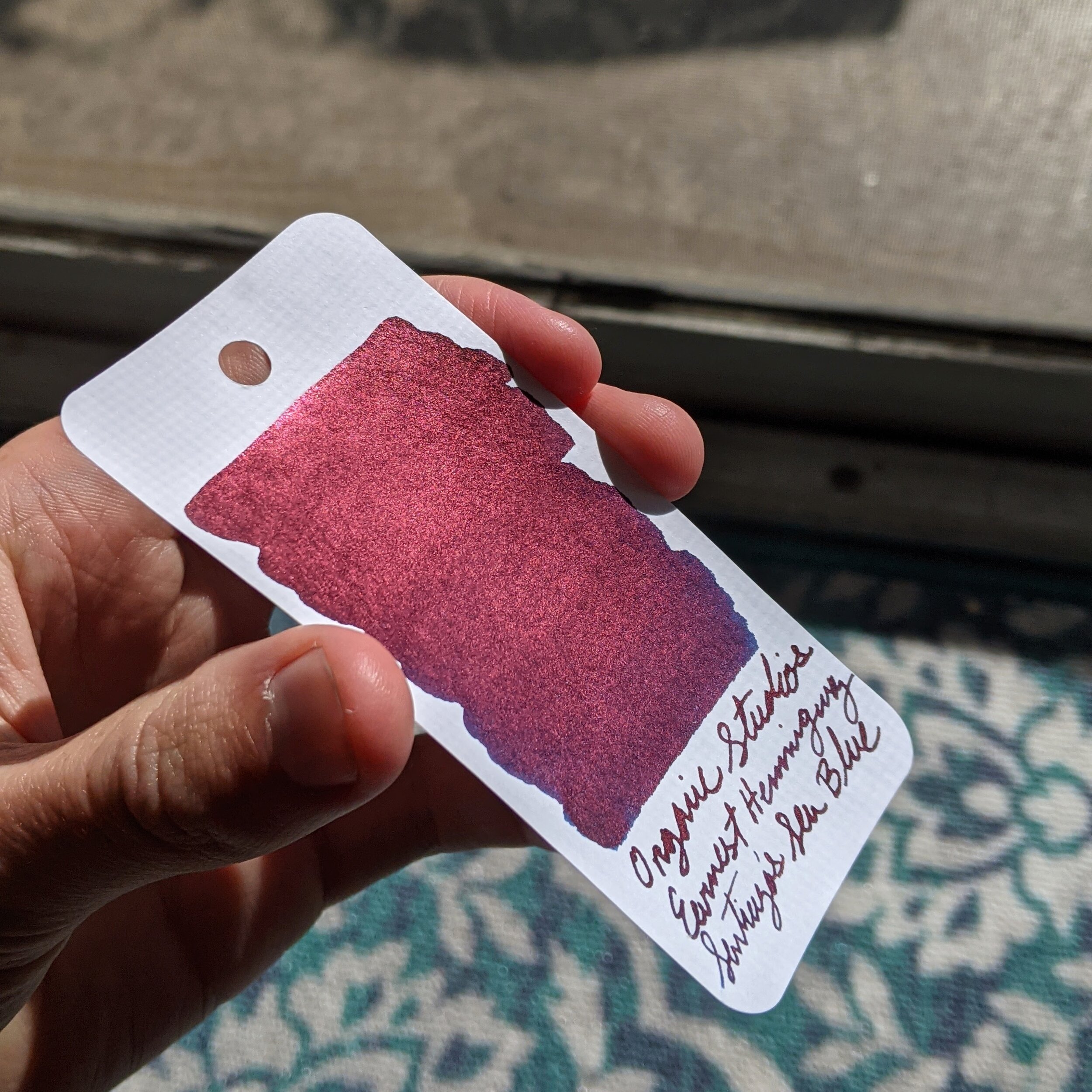
One thing that links most of the good sheeners together is that they are very saturated inks, meaning that they have a lot of dye in them. This excess amount of dye makes it so it does not all soak into the page. Also, they might be a bit light on the surfactants leading to more issues with hard starts. If you dilute them or add any surfactants they will sheen much less or not at all. Also because they are mostly sitting on the top of the page they will dry very slowly and often not at all. You could probably smear OS Nitrogen years after you put it down because the problem is not actually the water drying but the dyes that are on top of the page.
Some inks will be slightly color changing but not actually be sheen. One way to tell if your ink is color changing is to tilt the page and the sheen should actually reflect the light. Anything that does not reflect the light is not sheen.
Color Changing inks
Color changing inks are something new that has been a craze in the past year or two. Prime examples of this are the Troublemaker inks that can’t seem to stay in stock no matter what, but also the Sailor studio inks like 123 or 224. They are often desaturated inks that are greyish or greenish in color.
Personally I find that most of these inks are very very dry which I think is a necessity to get the types of color separation that they need. The inks seem to rely on the wateriness of the ink and the non-absorption on the page to separate the different ink dyes apart from each other. It’s possible that some dyes are not as easily carried by the water and are left behind, or some dyes attach more easily to paper than others. Its hard to say, and even Sailor has admitted they when they create a color changing ink, like 123, that it is by mistake.
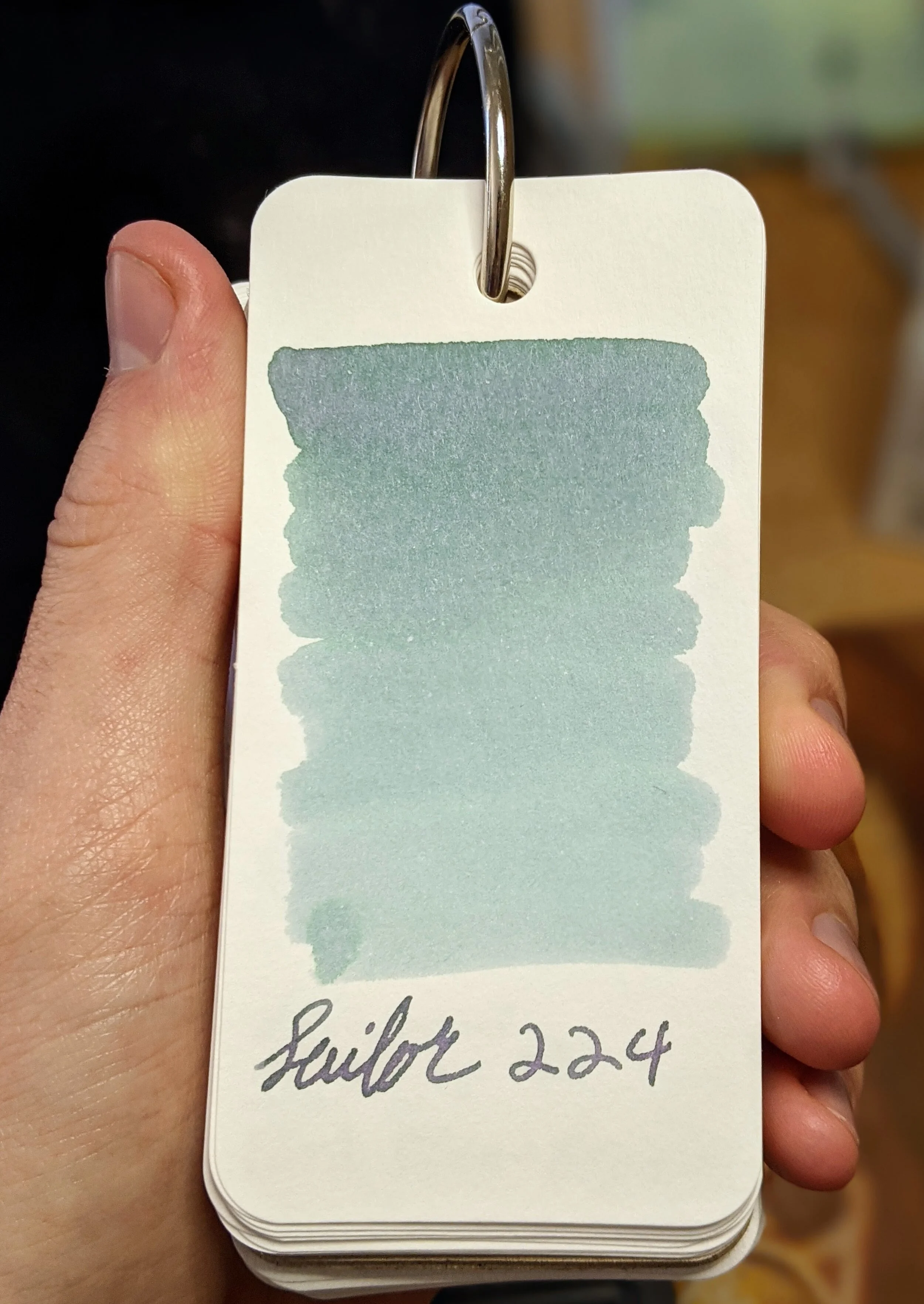
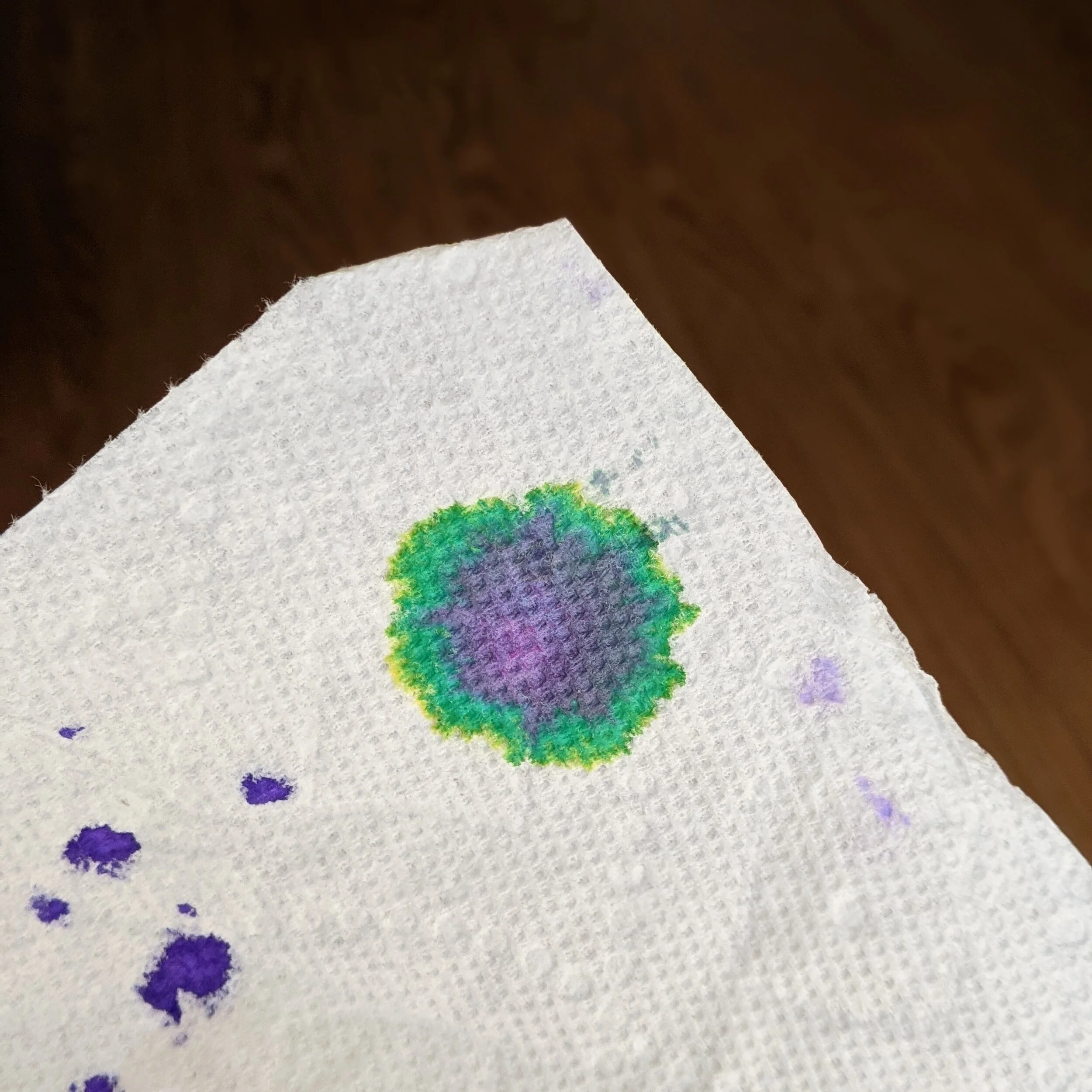
You can really see the color separation when you place it on a paper towel
I find these inks usually to be really fun and good for some interesting art, if a little hard to use because of their pale colors and flow issues.
Nano Pigments
You have probably heard that some caution is warranted for pigmented ink for fountain pens and rightly so. Traditional pigmented inks are not meant for fountain pens and even inks like Higgin’s advertise that they are fountain pen friendly. They are not fountain pen friendly and can ruin a pen very easily. Pigmented inks rely on solid particles that are small but are not actually dissolved in the water. This pigments can fall out of the solution and cause clogs that are very hard to deal with.
Nano pigments are a different story. They have diameters that are in the nanometer range (.000000001 meters) and therefore are much more easily suspended in the water than the traditional particles. Sailor Nano-Pigment and Platinum Carbon Black are the immediate examples that I can think of. Anything from a major fountain pen brand should be fine.
Nano-Pigmented inks have a lot of things going for them in terms of special properties. They are waterproof and they are very feather resistant so it makes for a really well behaved and useful ink. I would caution against letting either dry out in your pen. I have done that with Platinum carbon black, and I had to pull the feed but other than that it wasn’t too hard to fix.
Iron Gall
Iron gall inks are a special case when it comes to inks and play by completely different rules. They are the inks that were used a long time ago and are considered somewhat of a legacy ink. There have always been iron gall inks for fountain pens and there are plenty still available today. At the time of writing this, Pelikan Blue Black and Rohrer and Klingner Salix are some common iron gall inks. Also KWZ has an interesting line of inks though apparently they are somewhat more dangerous when used with steel nibs (apparently it caused some corrosion on some TWSBI Vac pens). They may have fixed these issues as can be seen here.
Iron gall inks were originally made by dissolving iron with oak galls in the 5th century. The acidity of the oak galls could dissolve the iron into solution and create an ink. This type of ink has one main problem with it, the acidity. The acidity of the original iron gall formulas could actually eat the page away after long periods of time.
So why use iron gall inks? Well modern formulations are much more mild (though different brands will have different effects) because the balance between the dissolving acid and the iron is much closer together allow for much less excess acid. This is because the acid is forming ions with the iron that are much less reactive than the acid by itself. Also the modern materials used in pens are much less likely to be eaten than those that came before them. Gold nibs and stainless steel are much more resistant to the types of acids that are used in these modern iron gall inks. Another reason is that iron gall is completely waterproof. The iron gall penetrates into the page and turns into ferric tannate which is non water soluble. Also iron gall is the best ink that I have ever used when it comes to bad paper. It does not feather very much and is an ideal ink for using at work when combined with it waterproofness.
One factor for the use of iron gall is the coolness factor. Because of the iron in the mixture the ink will actually change colors becoming darker and darker. As you write line by line you can actually see the change in color as the iron oxidizes.
I tend not to use iron gall inks because they may have some type of corroding effect over time. KWZ inks have been experimented with and can in fact do some damage to certain steel nibs so I’d exercise caution in this case.
Inks Inks Inks
I’m glad to see that new types of inks are on the market in recent years, with all kinds of properties. I hope to do more of a deep dive in the future with some of these various types of inks as it feels like I’ve only really scratched the surface of what is already out there. I am always searching around for new types of inks to try out so if you find anything interesting don’t hesitate to send an email it my way at minabekopens@gmail.com. Topic suggestions are always welcome!
If you are a chemist or are looking to make your own ink and have some questions or corrections I’d also like to hear from you. My goal is that this can be a community driven resource compiled with knowledge from everyone.
If you liked this article and want to see more please share it around with some friends! If you want to be notified of when I post you can follow me on Reddit and Instagram. If you want to donate or anything like that feel free to sign up for my Patreon it really helps me out with the hosting fees and you get some fun perks.
Thanks!
Minabeko