General Feed Primer
In my opinion, feeds are the hardest part of the pen to understand and the most dangerous to modify. So here I hope to lay out the general theory of how feeds work in preparation for an article about how exactly to modify them for wetness.
First I’ll lay out some groundwork and explain some of the terms that I’m going to use then talk about some different feed designs with some example photos and talk about what exactly each one brings to the table.
I’d also like to take this time to say that these are all theories that I have come up with or come across from a general grounding in fluid mechanics. I am not an expert so some of this is not set in stone.
Capillary action:
People always talk about capillary action and how it allows ink to flow through feeds but always stop without explaining exactly what that means. To say it as quickly as possible water has two main forces that govern how it behaves (for the purposes of ink flow).
One is adhesive forces which accounts for how well water sticks to things, also known as wettability. The other is cohesive forces which keep the water sticking to itself. Cohesive forces are responsible for forming water into drops. Capillary action works as a result of those two different forces working together. The adhesive forces work to let the water spread down the ink channel by spreading out more and cohesive forces work to keep the water in one continuous body.
This is why adding surfactants, like dish soap, will increase the flow of ink. Surfactants change the properties of the water in the ink, but that is an article for another time. Suffice to say that ink makers will change the properties of the ink to make the capillary action work well.
This capillary action is the same for the nib slit itself. There are some differences when talking about a flex nib, however.
Materials:
This is a basic overview of the two different material choices for feed types. The material makes a large difference to the flow in theory (though I have never actually tested two feeds of the same shape and a different material).
Thermoplastic:
This is the current standard for most production pens and is used by all the major pen manufacturers such as Pilot, Lamy, Sailor, Platinum, Jowo, Bock, and many others. There are a few reasons that this is used over ebonite. First, when people talk about thermoplastics they just mean plastic that melts at a low temperature. ABS is a very common plastic that is used for similar designs and it melts at 250C or 482F. This is important because the feed is made by injection molding where the melted plastic is injected into a mold and then pushed out after it cools slightly.
This will inform the design of the feed to a large extent. There are several considerations that must be taken into account. If there is interest I can do a little bit more research in this area but suffice to say that this method is extremely quick and cheap compared to say making it on a lathe as many ebonite feeds are.
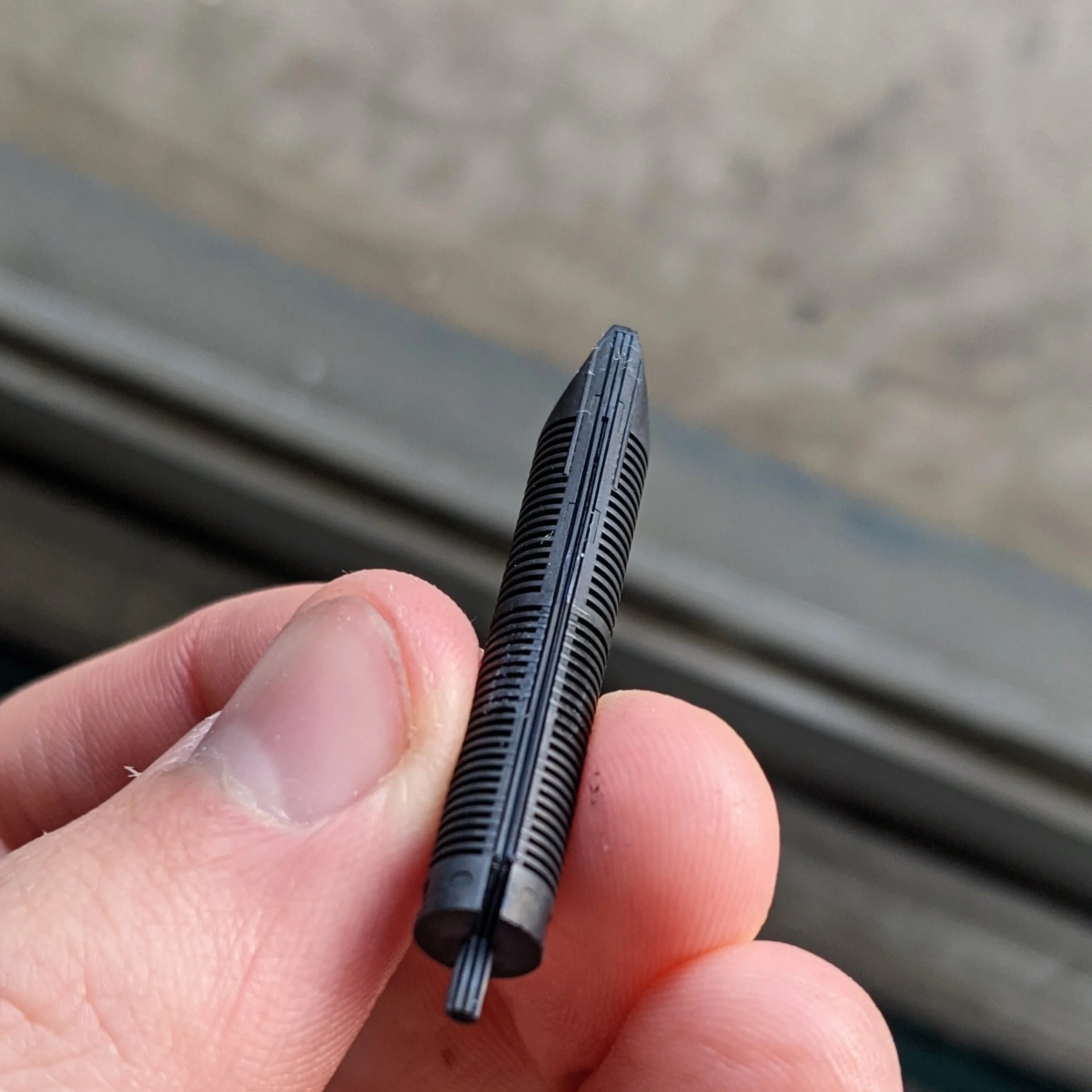
This is a Visconti thermoplastic feed that they use for their larger pens like the Homosapiens
Ebonite:
Ebonite feeds are a much more “special” feed in terms of how often you see it available on a pen. It is the traditional feed material that you will see in vintage pens from the early 20th century (or late 19th). It has a few properties that are not so desirable but some traits that make it an excellent choice for feeds.
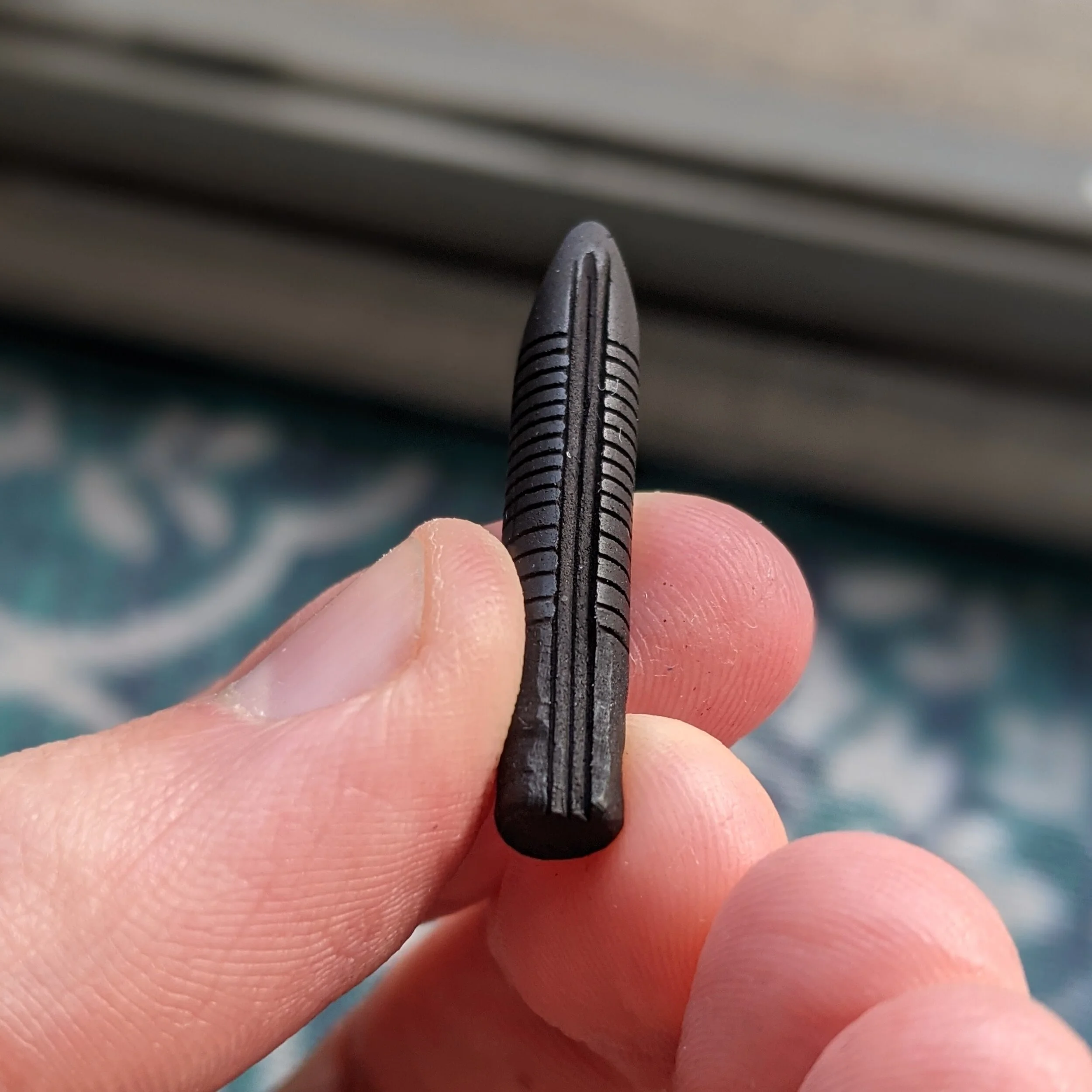
Here is an example of an ebonite feed from Fountain pen revolution. I suspect that Noodler’s also uses the same exact manufacturer
Ebonite the trade name of a type of vulcanized hard rubber. This is just a way of saying that it is a natural rubber that is infused with some amount of sulfur and linseed oil (25-80%).
The main reason for using ebonite is because of its wettability (which was mentioned in the section on capillary action). I know this sounds a bit technical but it is a fairly simple concept. A good example is to talk about a drop of water on a hard surface like glass. On some surfaces, a drop of water will ball up into little drops that are somewhat spherical. However, on other surfaces, the water will spread out and be much more flat. This property is called wettability. Ebonite has fairly high wettability properties so a drop of water on an ebonite surface would spread out more than on a thermoplastic like ABS. This is what makes flow better in ebonite feeds compared to ABS feeds.
Ink and Air Exchange:
The key to a feed is the air and ink exchange that happens. An appropriate amount of air must be exchanged for the ink flow to be as it should. A useful way to think about this is to imagine the two extremes of ink flow.
The first is to imagine your finger on the end of a straw filled with water. The water doesn’t fall out even though you expect it to from gravity. The water does not fall out of the straw because of the negative pressure it creates. This is one extreme with no flow going on, this would result in a pen that does not write at all. The other extreme is to imagine taking your finger off the end of the straw. This lets all the water out at once. This would make the pen let out all of its ink all at once and that wouldn’t work either, it would just spill everywhere. This is the same reason if you’ve ever put a feed back into a section and didn't seat it quite right it may have leaked.
You can imagine being able to meet at some kind of sweet spot where you can allow very small amounts of air around your finger so the proper amount of water is let out of the straw. The ink channel is like your finger. The wider you make the channel the more ink can flow out at once.
However, it is a little more complicated than that. You are not attempting to have a constant flow out of the nib, that would lead to ink dripping out of the feed. So how do you let air in but not have the ink drip out of the end? The answer is in the cohesive and adhesive forces mentioned above.
When the ink and air exchange is right the cohesive forces are enough to hold the ink inside the pen without it dripping. This is why when cohesive forces are lowered to a certain point (such as adding too much surfactant/dish soap) you can have ink that drips out of your pen.
Then when you put the nib down on the page the ink in the end of the nib will “stick” to the page from the adhesive forces in the water. As long as you write it should keep the ink flowing because as mentioned above the cohesive forces make the water want to be a continuous body. Then when you lift off the page you exceed the cohesive force and break the stream.
The whole time this is happening air is flowing back into the feed and into the ink reservoir. It is similar to how a large bottle with a small opening will glug. The air is trying to replace the water while the water is flowing out (though less violently than a bottle glugging).
Ink Channels:
At the risk of overstating their importance, ink channels are the center of the fountain pen. They are one of the most delicate features of a fountain pen and one of the hardest to get right. People rarely modify them in the same way that they do nibs. This is due to several reasons but the main one being that if you mess up there isn’t any (simple) way to fix the feed. If you remove material and remove too much you have to buy a new one unless you plan on adding material. Also because people rarely modify them there isn’t much knowledge about them.
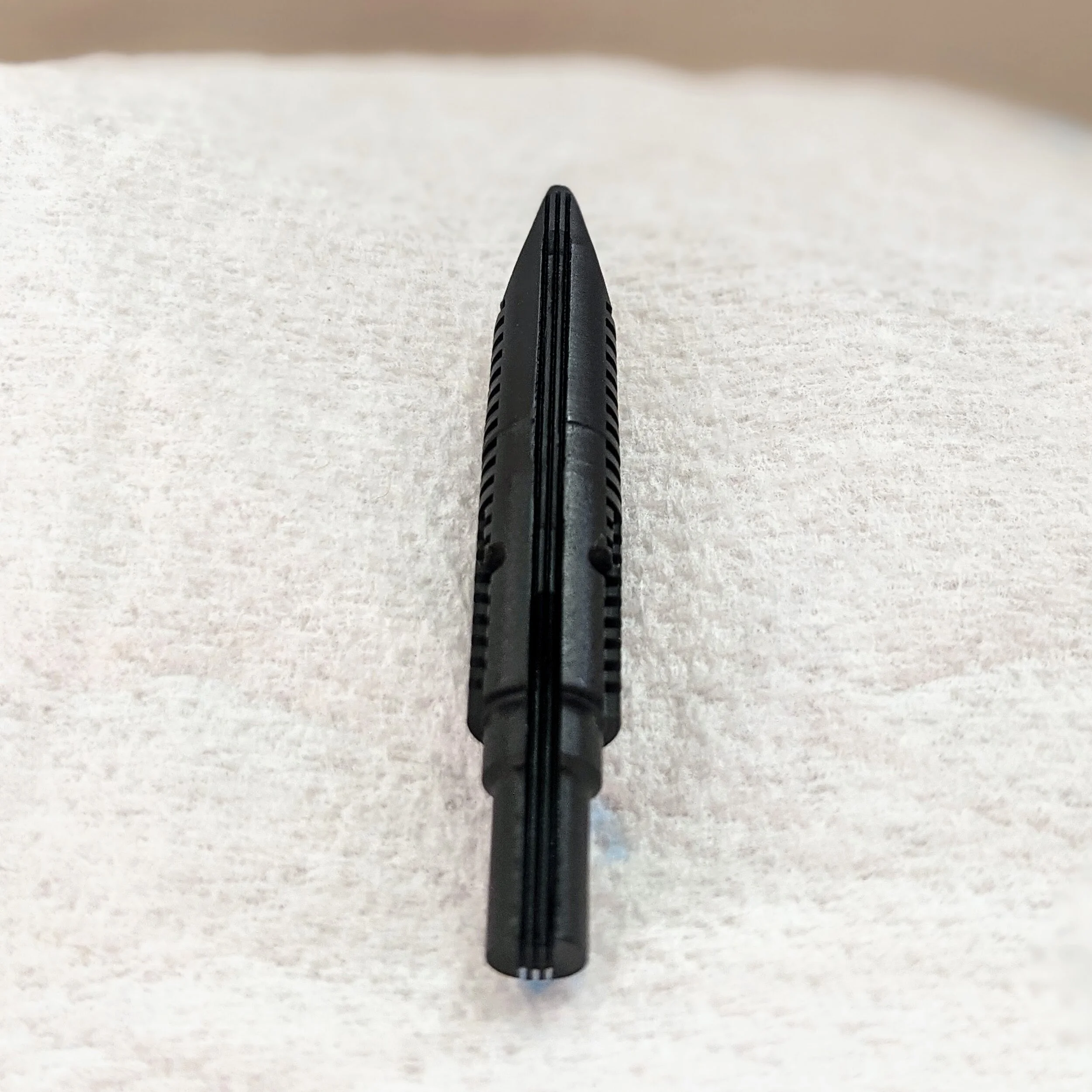
Here is an example of a feed made by Flexible Nib Factory for a Pilot CH 742 #10 FA nib. You can see this has 3 ink channels/slits compared to the regular Pilot feed.
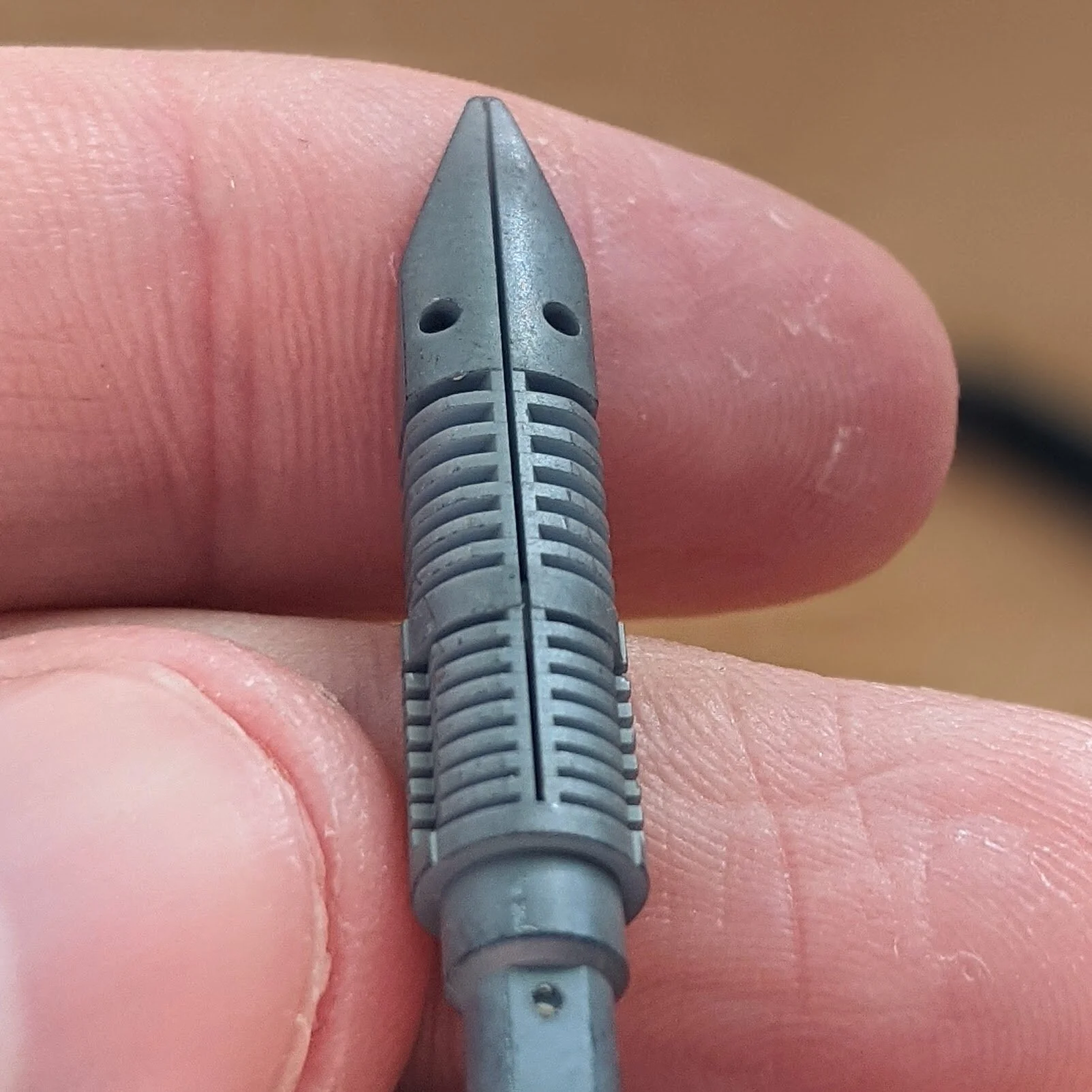
Here is an example of a regular thermoplastic feed from that Pilot CH 742 with an FA nib. This feed does not keep up as well as the Flexible Nib Factory feed.
The main goal of understanding the feed channels would be to widen them. Seems fairly straightforward and it mostly is. A good way to explain this is to talk again about extremes. If the ink channel is too narrow there will not be enough air exchange and the pen will be dry. If the air channel is extremely wide the ink would just fall directly out of the pen. But if the feed is not shaped correctly you can have a problem where the ink flow does not happen at all.
There will be a certain optimal width range that allows for capillary action to take place. For example, placing a large tube into water will not “wick” up any of the water. But placing a napkin will always wick up the water. A fountain pen feed is somewhere in the middle of those two things. It has channels wider than a napkin (whose channels are between fibers) but smaller than a tube. A well-made feed should be able to fight gravity when its end is being placed into water and be able to wick up some up. Finding the optimal range for these to occur would take a fair bit of fluid mechanics and material science understanding. The best option if you are making your own feeds is to copy what others have done or experiment rather than trying an analytical solution.
One thing that is fairly certain about them is they must taper up when getting to the end of the feed. By this I mean the ink channel must not be allowed to go out of the front of the feed. It must slope up and not reach the end. This I have seen as a warning in many places, I suspect that is because all of the ink would just fall out.
Fins:
Fins have an interesting part when it comes to how it makes a feed work. It is not strictly necessary as you can see there are older feeds that don’t have any feeds at all and some ebonite feeds like Noodler’s have very shallow fins while modern plastic feeds have a lot of deep fins.
In the end, the only real function of a fin is to catch the excess ink. If there is too much ink flow (the reasons for which I will talk about in future articles) then the fins can hold a certain amount of ink. You can see this in action when you dip a pen in ink. It will actually hold the ink in the fins. If the fins weren’t there then the ink would flow out of the end of the nib and drip. This is fine when you are dipping a pen as you can just let it drip back into the bottle, but if this happens when you are writing, fins are a great help so that you don’t leave large ink blobs.