Nib Shaping Primer
As promised here is my article on how the overall shape of a nib will affect the writing experience. If you haven’t read last week's article on Nib Metallurgy I would suggest checking that out before reading as it will clarify a few points I make.
In this article, I will cover some of the basics of nib shape and its effect on flex, flow, and even nib squeaking. I will try my best to explain the underlying principles surrounding these phenomena in an easily digestible way. I hope you enjoy it!
So You Want to Make a Flex Nib:
I figure that many of the people who are looking at this article now have at least thought about making a flex nib. People have been looking for replacements for vintage flex as older pens start to show their age. So how does one go about making a flex nib?
There are two different ways to make a nib flex more, one is to thin out the tines and one is to create cutouts. Both are viable options with the latter gaining in popularity in the past few years with Kirk Speer’s Secretary de Flex and Stilosuites nibs.
Bending Moments:
This may be a little in the weeds (though to be honest this entire blog is a little in the weeds), but it is essential to understand why thinning out a nib works so well. In the engineering space, flexing is called a deflection (or strain) and deflections are caused by stresses.
You may remember in my last article that we talked about stress. Stress can be thought of as compression or stretching. More formally, stress is a force over an area. This happens with any amount of force on any object.
For example, if I were to press down on my desk with my finger the desk would be experiencing stress. As per my last article if you place an object under enough stress you can bend that object and eventually break it. The same is true of your nib when you are writing or trying to flex it. You are putting stress on the nib and therefore the nib deflects.
But bending is a little more complicated than that. Let's say you are pressing down hard on a nib and it is bending upward. When you are doing this what is happening is that the bottom of the nib is being slightly stretched and the top of the nib is being slightly compressed. This stretching and compression are stresses that are on the nib. It turns out that the thinner and longer the nib gets (or any material) the greater those stresses become.
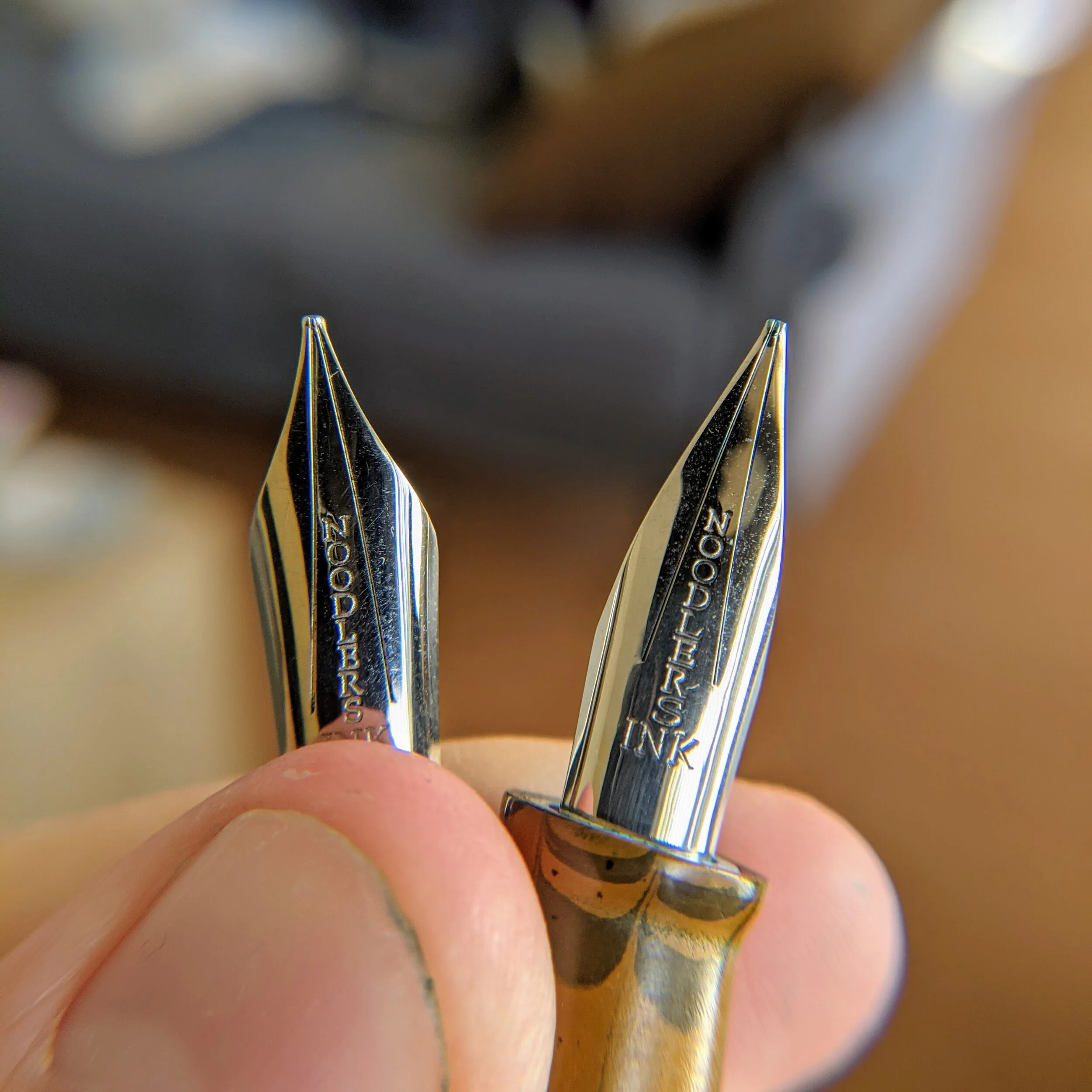
Two Noodler’s music nibs, one from a Triple Tail and one from a Neponset. The smaller shoulders of the Triple Tail nib makes it a much softer nib.
This is governed by an equation that depends on a few different things. The torque* on the nib, the thickness of the nib, and the width of the nib are all taken into account but they will have different effects on how much the nib will bend. The aspects that will affect the amount the nib bends the most are the thickness and the length of the nib, they both have a cubic relationship with stress on a nib.
*The force on the end of the nib times the length of the nib
For example, let's say that you doubled the thickness of the nib you would reduce the amount of stress (and therefore deflection) by 8 (2x2x2). If you doubled the length of the nib the deflection at the tip would be multiplied by 8 as well. On the other hand, if you doubled the width of the nib or the force on the end of the nib you would only half or double the deflection respectively.
So making nibs thinner and longer is the real solution then, right? Well, the increase in the deflection also corresponds with an increase in the amount of stress that the nib is experiencing and will make it more likely that the nib springs, bending past easy repair.
Using these techniques to make a flex nib is not anything new; it's the most common way to make modern flex. Cutouts, such as in the Pilot Falcon or the Secretary de Flex, make parts of the nib less wide and allows for more stress to be placed on those areas, but with less force. This is what makes those nibs softer and more responsive.
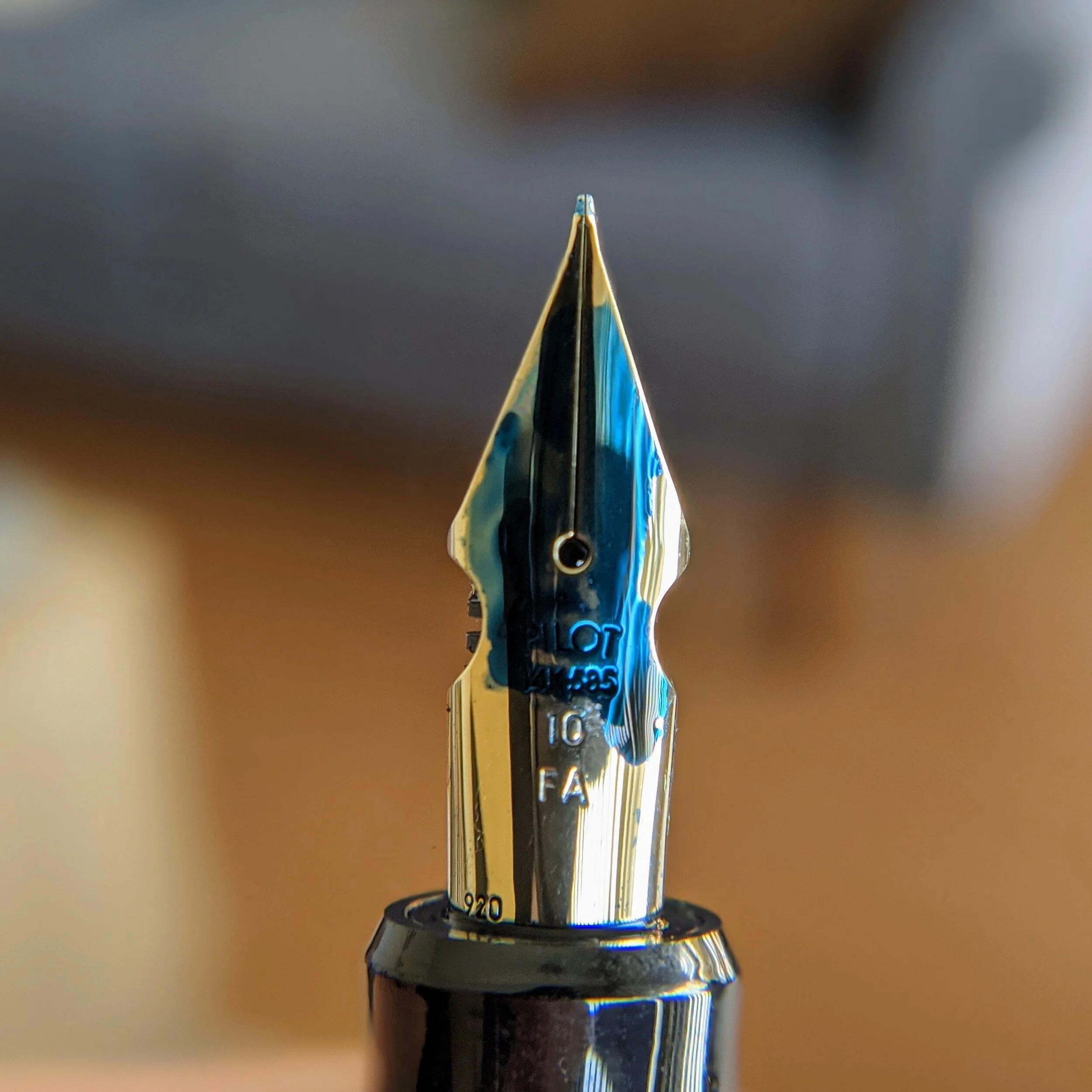
Pilot falcon with cutouts a very soft nib
You could start to do some very interesting things with this type of experimentation. Many nib meisters will add flex to a pen by making the tines less wide, but what if they shaved it down on just the tines? By making just one part thin and one part thick you will start to get all kinds of interesting effects that I will go into when I do my article on flex nibs.
Spread vs Bend:
So now that we know what makes a nib soft but this is likely not news to you even if you didn't know the exact mechanisms that it worked by. But do we want as much bending upward as possible? What we want is to have the greatest amount of spread possible. In fact, upward bending is not desirable in a flex pen. The farther the nib is away from the feed the more likely you are to break capillary action and get railroading.
The nib must have a curvature to accomplish this type of spreading. The curvature of the nib around the feed allows the nib to be able to turn the upward pressure into an outward pressure.
The better a nib can do this the wider the line will be and the less railroading there will be.
However, the tradeoff is that the more the nib curves the stiffer the nib will be. The best nibs will have some kind of tradeoff between these two things.
Tine Cuts:
The length of the tine slit will also affect how well the nib can spread. This is the reason why modern flex nibs like Noodler’s or FPR Ultra-flex nibs have such a long slit down the middle. The longer the slit the easier it is to translate the upward bending into outward motion. The steel in those nibs is stiff and would not be able to bend enough so the long slit down the middle allows the torque to be greater not by increasing the force, but by increasing the length.
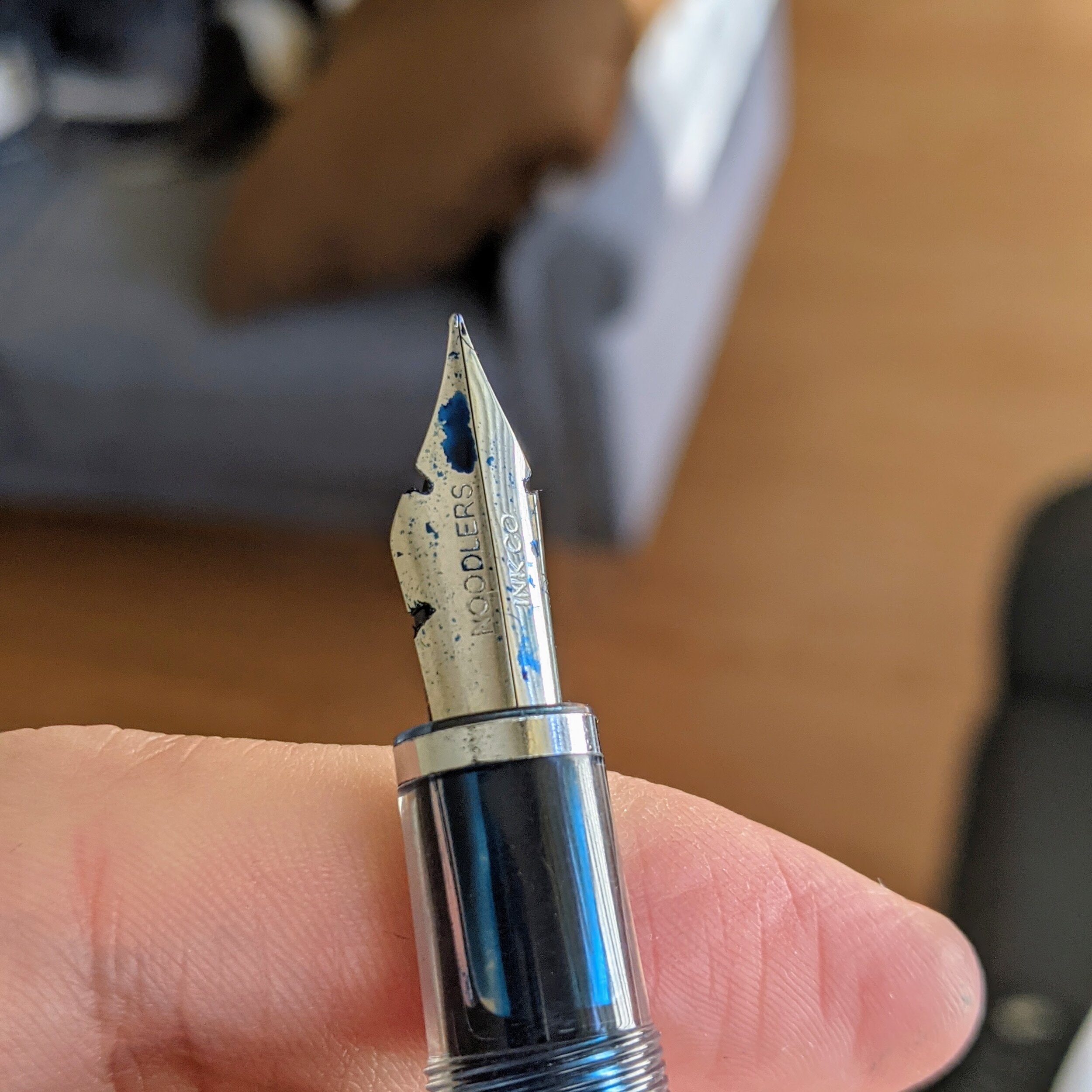
Here is a Noodler’s pen that I’ve modified for more flex
The other effect of this design is that the entire nib will bend rather than just (or mostly) the tines of the nib. The more the entire nib bends the farther it gets away from the feed and the more likely you are to get railroading. You can check this yourself and see that when you use a Noodler’s nib the entire nib curves off the feed whereas in vintage pens the tines do the majority of the flexing.
Squeaking Problems:
Shifting gears to something completely different I hear a lot of people ask about whether or not their nib should “squeak” or “sing”. Very loud nibs are one thing but there is something distinct about when your pen is making that high-pitched squeaking sound. Many people don't find it desirable and wonder how to get rid of it.
All items have what are called resonance frequencies. They are just the particular pitches that an object likes to vibrate at. You’ve seen this demonstrated when someone breaks a glass with their voice. They hum at a certain pitch and the glass vibrates more and more. The same is true of nibs. When you have a pen on paper some slight vibrations occur when writing. If the vibrations happen to be in the range that the nib resonates at you will get some squeaking. This can be changed by changing the paper or the surface finish of the nib. The small bumps on the page and the nib are what create these vibrations so changing either of them will stop the squeaking.
It's also fair to say that some nibs will be more prone to this type of thing than others. The types of vibrations produced from pen on paper are likely bound to a certain range. There is likely to be a range of pitches that pen and paper are likely to produce. If the nib has a resonance in that range you will get squeaking with that nib more often than others.
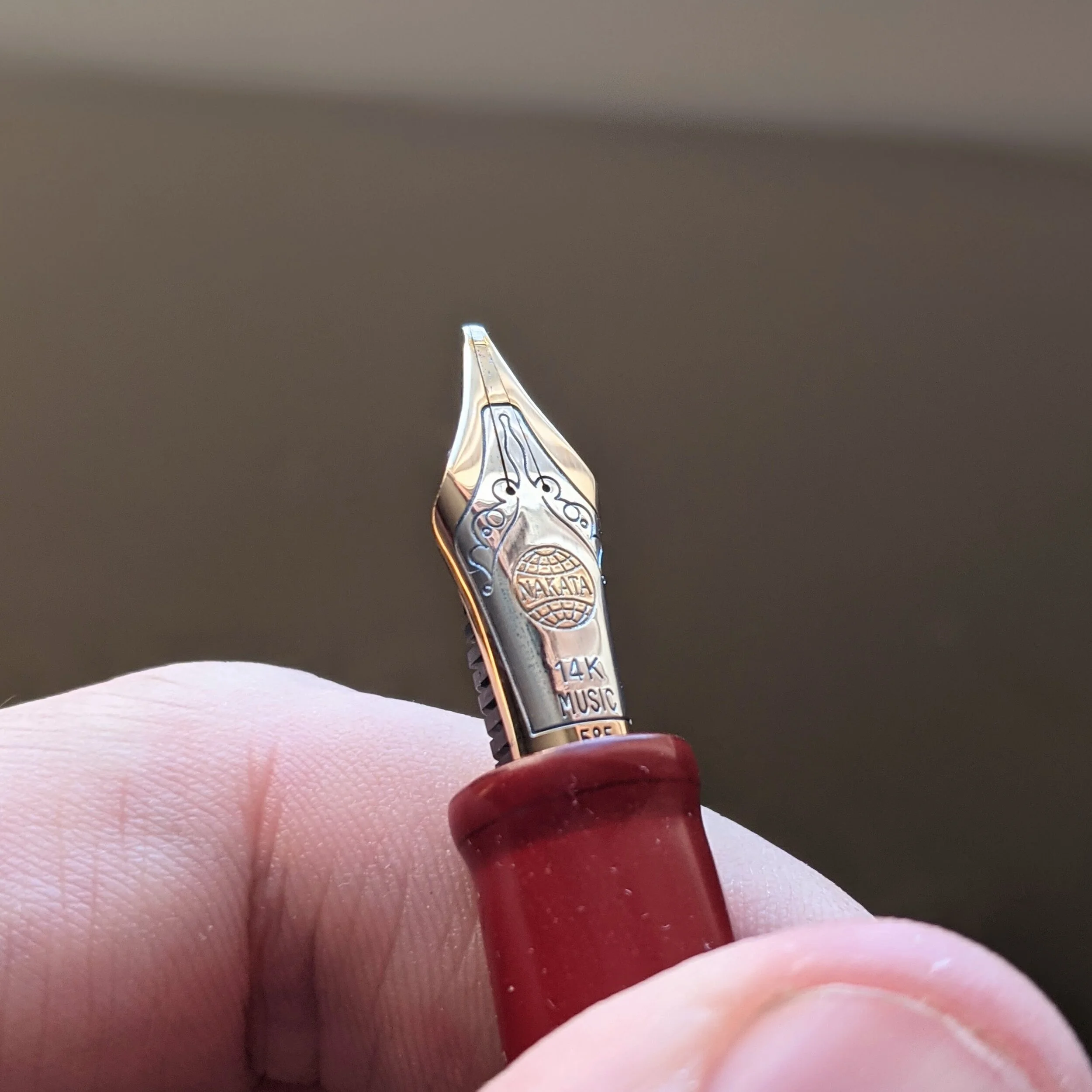
I find that Platinum nibs especially my music nibs are very squeaky
Nib shaping:
I hope this helps people understand how exactly nibs are affected by their shapes. I hope you liked this article. I’m hoping these articles can become the basis for a better understanding of fountain pens and how they work. If you want to be notified of when I post (usually once a week) you can follow my Instagram @mianbeko_ where I make posts for new articles. If you want to support me and what I’m doing here I do have a Patreon here.
-Minabeko